Sunday, May 1, 2016

People of the Book


As Christians, we are people of the Book (people of the Book are adherents of Abrahamic religions that pre-date Islam). This morning in church our pastor led us in a powerful call to worship where we proclaimed ourselves to be People of the Book, people of the Word, people bound to the person of Truth, Jesus Christ. It was sweet to stand among fellow believers, Bibles raised, and proclaim our faith together.

Having just come off of two back-to-back conferences, where I've done nothing but breathe, sleep and think education, specifically classical, I had an epiphany.

When we memorize something, we are writing on the book of our minds and hearts. Last week, Cub memorized and delivered 9 minutes of Patrick Henry's speech, "Give Me Liberty or Give Me Death." I unabashedly chose the speech for him. I wanted him to own the beauty of Patrick Henry's words, the profound theology, the courage and faith, of a man who was willing to lose everything for an idea, a hope, a dream... freedom.

He could have read the speech and enjoyed it and left it at that. But memorizing the speech and presenting it wrote the words on his heart, they are now part of the book of his life. He owns them forevermore.

Part of the sad state of our culture is due to the fact that we overview and use google-fu instead of memorize. We don't take the time to intellectually own facts, scripture, speeches, plays or sermons through memory work. It's like we've raised an entire generation of people who walk around with books full of blank pages.

We are called to be People of the Word, and so we must never under-estimate the value of Words. We are also People of the Book. Do yourself, and your kids, a favor and write great words, awe-inspiring, profound words, in their hearts and minds- memorize!

If you don't have any of your own yet, borrow some. Great men and women are always willing to share.

Find more great articles on Classical Education at Trivium Tuesdays

 @Golden Grasses 2008-2013. All photographs, artwork and text are the property of the owner unless otherwise stated. Don't miss a thing! Subscribe to Golden Grasses and get our articles right to your inbox!

Monday, April 18, 2016

Homeschool Heart Dissection - Challenge A Fun!


For weeks, the kids in Challenge A have been drawing the systems of the body; in detail, with labels. It's been a great exercise! 
We capped off our anatomy studies with a cow heart dissection. One of our families provided us with 5 cow hearts from a local slaughter house, another family provided professional dissection tools, and the older sister of some of our Challenge 1 students (an upper level nursing student) came in to demo just how to look at, explore and understand the heart. 
Thank-you, Sarah!! 

5 hearts- enough for every one to get their (gloved) hands dirty.

No cutting was done, until the kids had thoroughly observed and explored the heart visually and kinesthetically.

We love our host church facility! The kitchen was perfect- we taped down cheap plastic tables clothes, watched a PowerPoint on heart dissection and got to work!

We have amazing parent support in our Challenge community! 
Love our families!

A fantastic end to a wonderful semester of hands-on-learning!


 @Golden Grasses 2008-2013. All photographs, artwork and text are the property of the owner unless otherwise stated. Don't miss a thing! Subscribe to Golden Grasses and get our articles right to your inbox!

Saturday, April 16, 2016

Challenge A Games & Resources

We have kept super busy this year with 2 Challenge programs, a college student coming and going a job, or two, Directing Challenge A and a few other things- too much painting of offices, for sure. But, now that we winding up Challenge, I wanted to record some of the games, resources and schedule we used before I forget them all and so that I have a handy reference for training this summer.

Here Goes:

We started each Community Day with a short devotional and scripture reading. We sing the Doxology, say it in Latin or pray.
Then we write 5 and 5 (5 Common Topics/ 5 Cannons of Rhetoric)
Then we'd dive in to the 6 Seminars.

Latin- the kids loved Latin Scrabble. I had two sets of tiles divided between 5 groups of two each. They could add in 2 vowels and 3 consonants as needed. They could use the Latin dictionary or other Latin words as long as they were used correctly and declined/ conjugated correctly.  Often, the teams competed against each other, seeing how many sentences they could create in a limited time- they had to have their sentences checked by an adult.
To change it up: They would have to create a question using Ubi, Ibi, Cur, Quis or Quid. They would get a point for every questions created. If we had time they would then have the group next to them form an answer to their question in Latin with their tiles - this created some hilarious results!

Latin stations- several times I would put info we've studied on file cards- for instance: Latin declensions, conjugations, Grammar rules, translation from English to Latin or vice-versa - and tape them around the room. I relied heavily on the homework that we'd completed as well as Memoria Press Guides to Henle. I would intersperse the information with difficult and simple problems. The kids would go around the room in whatever order they wanted and try to solve/answer as many cards as possible in a given time.

We also played Latin bingo with Personal Pronouns.
We copied charts in class.
Every Community Day we spent 10 minutes chanting Latin charts, which I purchased from Memoria Press. I highly recommend having them professionally laminated.

We would race to see who could translate and diagram Latin sentences the fastest.

Mold, Act, Draw. I just found this game but will be playing it this coming week- the kids LOVE clay! Make a simple spinner and put Mold on it twice, Act on it twice and Draw on it twice. Student picks a vocab word from a deck and spins the spinner. They have to either mold with clay, act it out like charades or draw it out like pictionary. Set timer for 60 seconds.


Math
We did student directed Math Discussion for every seminar and then I would introduce the Saxon lessons. I created a Math Discussion sheet based on the 5 Common Topics; starting with "Definitions." The kids had to thoroughly exhaust each section before they could.
Board Slam was our best diversion - the kids continue to love it. One of our moms donated a huge bag of dice for the year and it included many different sided dice. To change it up, I'd allow the kids to pick different sided dice. We'd also set the timer for a minute and at the end of the timer the kids would have to trade their board with someone else and pick up where they'd left off.

LTW

I copied off the terms we'd learned in Lost Tools of Writing and cut them in to slips. Divide the kids into groups and they have to take the slips of paper, put them in order for a Persuasive Essay. Then, I would give the kids a topic- like the Burning Bush, or The Three Little Pigs and they would have 15 minutes to write a collaborative essay on the topic (usually only with 2 proofs for the sake of time).

Dictionary Game- the kids loved this. I would take vocab words from the reading and say/spell the words to teams- between 10-25 words, depending on how much time we had. The teams would look up and define the terms. The team with the most correctly defined terms withing a specific time limit won. Extra points for making Latin connections.

Rhetoric 
The biggest hit this year was Socratic Circles. At the beginning of the year, I would choose the topic but as the kids got more familiar with it, they would choose the topic. Great discussion!
I would also assign the kids roles to play-act: God, Moses, Charles Darwin, etc and the "audience" would ask them questions. GREAT interaction about issues related to It Couldn't Just Happen.
To review Fallacies the kids would randomly pick 3-5 fallacies/catechisms and have 10 minutes to come up with a skit that included them all. The rest of the class would try to guess what they had portrayed. This made for much hilarity.
Have the kids search for fallacies in real life- they are everywhere! Whoever brings in the most, wins points!
And, of course, we played Jeopardy.

Science
For Science, I printed off a list of things to include in their presentations as well as how to create a good presentation. The kids earned points for things like making eye-contact, introducing themselves and their topic, etc.
For body systems- once we had a few under our belt, I printed off sheets for the systems and numbered them, but not in the same order. The kids had to draw and label them in the ordered number and had to complete the lesser numbers in order to earn the higher number points. They could strategize and have multiple people drawing at the same time, but I usually gave them between 10-15 minutes to draw up to all 9 systems.

Debate
We played "Around the World" often-the kids enjoyed this.
We also played "Family Feud." I person from 2 teams would be at the front. I would give clues about a country, capital or feature and the first person to guess within 1 minute would get a point.
We often played pictionary for geography terms. The kids loved it!
My goal to end each Community Day was to go through "Collect, Connect, Compose" but I wasn't very consistent on it. Collect what they've learned that day, connect it to something they've already known and compose a poem, song, ditty, drawing, etc. about it. Great integration.

Points- I had a simple point system based on Fabas (Latin for "bean.") Kids got points for completing all homework in each strand, for winning games, for integration of subject material, etc. We had a quart sized jar that the beans went into. Once the jar was full, I had an ice-cream party for the kids at lunch. The faba jar was super important to the kids until they earned an ice cream party and then it was important, but not something they thought about all of the time. In my mind, I think it was because they were internalizing how to manage the material, making connections automatically and understanding how to work the program.

That's it. We didn't have a huge array of games to choose from, but the ones we had we used often and had a great time with. Perhaps this will spark some good games for you to do with your class or kids. If so, I'd love to hear about it!

@Golden Grasses 2008-2013. All photographs, artwork and text are the property of the owner unless otherwise stated. Don't miss a thing! Subscribe to Golden Grasses and get our articles right to your inbox!

Tuesday, March 29, 2016

The Grammar of Poetry: On-line this Time


The Grammar of Poetry was THE first curriculum review I ever wrote. I wrote it because I LOVED the program; I was teaching it in a co-op and as a long time poet, fell in love. Since then, the program has been re-published by Roman Roads Media. I had the great pleasure of being chosen to write a review of Roman Roads Media's newly re-published Grammar of Poetry as well as Old Western Culture, taught by the imitable Wes Callihan. I immediately became a member of the I love Wes/ I love RRM fan club (no, it's not real, but lets talk a few minutes and I convince you that you do need most, if not ALL of the RRM published curriculum!).

And then, because Dr. Dh challenged me in an area (it's his way), I contacted RRM and we've been talking ever since. And now, I'll be working for them in a couple of capacities, including Book Rep AND teaching The Grammar of Poetry on-line as part of Roman Roads Media's flipped classroom program. I am super excited. Have I mentioned I love this program? If you want your kids to GET creative writing, to GET meter, to understand the beauty of poetry and good writing, you really want to check out this curriculum. And, if you love fabulous curriculum, master teachers and inspiring lessons you want to spend some time on the Roman Roads Media site.

And see that cute crowd above? They are just a few of my former Grammar of Poetry students.

All photographs, artwork and text are the property of the owner unless otherwise stated. Don't miss a thing! Subscribe to Golden Grasses and get our articles right to your inbox!

Sunday, March 27, 2016

That's My King


http://i1297.photobucket.com/albums/ag30/Lisa_Nehring/siggywithflower_zps2ffa66ba.png@Golden Grasses 2008-2013. All photographs, artwork and text are the property of the owner unless otherwise stated. Don't miss a thing! Subscribe to Golden Grasses and get our articles right to your inbox!

Sunday, March 20, 2016

What are We Fighting For? Virtual Curriculum Fair- Seeking Beauty


Join Drama Class my senior year... Get back to doing what made me happy in the old days.:

Because we are created in the Image of God- the ultimate Artist, it is no wonder that we have the deep desire to create, and the innate ability to respond to creativity. 
Art is integral to our homeschooling. It has taken many different forms over the course of 25 years but has always included some basics.
Nature studies.
Sketchbooks and colored pencils, pens, erasure, paints, markers
Time to think, reflect, ponder, mull
Drawing instruction
Vocabulary and word study
Excellent writing instruction
Humor -how to create and tell a good joke
Story telling
Scientific inquiry
Logic and recognition of fallacies
A good story
Books, movies, magazines, live events
Challenging activities
History
Theological studies
Theater and Public performance
Crafts
Event Planning and creating programs

I've done a fair bit of creating myself: photography, stained glass, basket weaving, painting, scrapbooking, journaling, poetry, writing, DIY, house-crafting, and all manner of fiber arts. It's just something I have to do. Dr. Dh is much the same way, though his creativity can often be found in areas like language studies (he's on his 3rd) and intensive intellectual pursuit. 

Which leads me to a point. True creativity and artistic instruction IS an intellectual pursuit. I created and taught a high school level Creative Writing Course a couple of years ago (best class evah- amazingly talented kids who really loved the work!) and they were shocked at the level of discipline the class demanded. We learned poetry forms and memorized poetry, did writing prompts weekly, had a word count to reach every week, books to read and so much more. Often we look at "art" as free-from expression and devoid of plan or purpose. In fact, classic art- that which spans time and culture, is the result of amazing discipline.


I propose that true art is mastery of a subject area that allows those participating in or viewing it to reach beyond themselves and hope for better things. C.S. Lewis's Narnia series is a great example. There are so many deep spiritual truths found in this simple imaginative tale, even the youngest reader can hear and see that God is good and for them. 

But does art always demand mastery? Well, no. We can take simple pleasure and enjoyment in a great many things without excelling at them. And along those lines, I don't buy the adage that practice makes perfect. Good, intentional practice allows us to reach for perfection. Schlock practice re-enforces bad methods and behavior.

And a brief discussion of curriculum. There are some brilliant curriculum's out there- you know the ones. They take a difficult or intimidating subject matter and make it accessible to the point that you ever wondered what was daunting in the first place- IEW, Lost Tools of Writing, Story and History of the WorldOld Western Culture, Classical Conversations, Henle Latin, The Grammar of Poetry, etc. It's not that the student doesn't have to actually do the work- it's that the work allows them to excel quickly and well. These curriculums are worth every penny. 

I've said it before and it bears repeating. Often what you are good at, your kids will excel at. Imitation and all of that, not to mention that it's far easier to teach what we know and understand. As a result our kids all know how to draw, cook, garden, write, speak, plan, study and memorize and understand exceedingly well theology, the Bible and scientific inquiry. Things I struggle with, they often do. But, that also allows them the added benefit of them watching me/us struggle through something that might be initially difficult- like dry-walling, or learning Latin.

This year our creative pursuits have included the study of Latin and integrating the culture and vocabulary in new and interesting ways, sculpture and drawing, ballroom dancing, cartography and nature sketches, along with weekly drawings of body systems, Flourish, debate, Drama, recitation, Shakespeare, the Piano Guys, Studio C, Tim Hawkins, Foyles's War, Dorothy Sayers mysteries on DVD, violin, music theory, straw bale gardening, DIY projects, an arbor and an amazing display of Christmas lights, along with some great books and CD's, You gotta have art.

Past Virtual Curriculum Fair Posts on Teaching Art


Stop by my blogger buddies sites and read more Virtual Curriculum Fair posts
Chareen @ Every Bed of Roses - Seeking Beauty Through the Arts
Yvie @ Gypsy Road - Art Museum Staycation & Elements of Art Unit
Sarah@ Delivering Grace - First Things First
Laura @ Day by Day in Our World - Add An Element of Beauty with Fine Arts in the Homeschool
Lisa@ Golden Grasses - What Are We Fighting For?
Annette @ A Net In Time - Art, art, and more art
Kristen @ Sunrise to Sunset - The Sounds of Music
Kym @ Homeschool Coffee Break - Music and Other Beautiful Things

All photographs, artwork and text are the property of the owner unless otherwise stated. Don't miss a thing! Subscribe to Golden Grasses and get our articles right to your inbox!

Sunday, March 13, 2016

Exploring & Discovering Around the World


If you've read much at GG you know that we are social science junkies. History and Science have always played a huge role in our homeschooling. This year is no different, but it has certainly taken on a different form than in past years with our involvement in Classical Conversations Challenge programs.

Flower, in Challenge A, has learned to draw and label the world by heart this year. She starts with a blank piece of paper and an atlas and goes from there. We have gone continent by continent, drawing, labeling, adding in features and rivers. Maps, globes, atlases have been out and about all year long. She is using our 3 x 5' whiteboard to draw on- it's bigger, she can use colored markers and she has had a blast putting in silly "keys, "features and gorgeous Compass Roses'. We are on Africa now, and have only Australia and Oceania to go. Blue book exams will ask the kids to draw and label the world, with 400 countries, capitals and features, having an hour to do so. Map- blobbing works just as well as fine cartography. We play weekly games in community day, such as around-the-world (one person starts the map, after a set amount of time, the kids rotate maps so by the time you get your map back, several people have already worked on it. This week, we are going to do a "family feud" type of game where I describe the country/ features by location, other geographic references, and the teams have to deduce what country or feature I am actually talking about.

Rhetoric this year has focused on Evolution and Fallacies. We have used the book, It Couldn't Just Happen for discussion, to learn the high lighting system and as a basis for the catechism cards. The book is simplistic in some ways, but does a great job of equipping kids with scientific facts and details. In addition to the book, the kids have memorized great stuff like, "What is good science," "What is the day-age theory," "What is a symbiotic relationship," etc. This semester, the kids are reading, The Fallacy Detective, and memorizing fallacies.

The kids are definitely learning that there is a cultural difference between those who believe in intelligent design and those who don't. During class we use Socratic Circles, play-acting, drama, jeopardy and more to discuss the issues, drill the catechisms and fallacies and integrate what we are learning with what we know already.

Science this year has focused on both the natural world and the human body. First semester the kids did research (using 2 sources) on a topic, such as "bats," or "cetaceans" to write a paragraph that they illustrated and gave a presentation on. I created a 20 point system with things like, "introduce self and topic," "makes eye contact," etc. where the kids could earn fabas (beans) towards an ice-cream party.
This semester, the kids are drawing and labeling parts of the body, such as bronchial system, heart, skin, etc. There is so much beauty and good learning done through copy-work and repetition! The kids bring in a cool fact, or disease, related to whatever they have drawn the week before. We are having amazing, amusing and oftentimes gross conversations about disease and wounds. Jr Highers have great stories (!) to tell!

Cub- Challenge 1, is having a much different experience this year with the Social Sciences- he is delving deeply in to Government, Economics and Debate- Econ has included a Cost of Living project, Debate has included individual events (he set a poem from Tolkien to music and sang it) and actual formal debates; last semester was on the Draft and this semester is on Immigration Reform. The kids don't know which side they'll be arguing and have had numerous study groups to prepare.
Additionally, both kids went to TeenPact's 4-day class this year, Cub as an alumni, along with the Political Communications 1-day class. Hands on learning at its best!

Science has focused on Physical Science using Apologia's Physical Science book, regular labs in class and a formal Lab notebook. In addition, he is writing a 15 page research paper on Mars. Yeah, he's full up, schedule wise.

What about history? We are getting plenty of it in the literature selections for this year- Cub just finished both "Up from Slavery" and "Life of Frederick Douglass" that fit in with the theme of freedom and U.S. History. Flower's reading focuses on 10 books that are Newberry Award Winners. I had the kids create a timeline of the protagonists for Blue Book. Great stuff!

For fun, Dr. Dh purchased the Lord Peter Wimsey series on DVD and we are currently mesmerized by Foyle's War. Murder Mysteries? Yes, both capture the period, the costuming and, I think, often the attitudes. Great discussion fodder.

In addition, we are listening Old Western Culture, by Wes Callihan every chance we get. So far we have gone through the Greeks and 1/2 the Romans. Reading the Iliad out loud might be on the schedule for this summer. Just saying. So, if you haven't heard of Wes Callihan or Old Western Culture, do yourself a favor. BEST curriculum evah!

I mention NOAA and NASA Web-sites every year- they are government sites that have excellent information- not to be overlooked!

Current awesome magazines we read cover to cover: Biblical Archeology Today and Artifax.

Past VCF Posts:
World Exploration'
The Social Sciences
Globe Trotting


Check out the other VCF posts this week:
Yvie @ Gypsy Road - Bringing It to Life! History, Geography, & Science 
Jen Altman @ Chestnut Grove Academy - Virtual Curriculum Fair 2016: Exploring Our World, How We Do Social Studies and Life/Earth Science 
Laura @ Day by Day in Our World - Learning About the World Around Us 
Chareen @ Every Bed of Roses - Social Studies a Science of Relations 
Lisa @ GoldenGrasses - Exploring & Discovering Around the World 
Annette @ A Net In Time - Science and Culture Around the World and at Home 
Kym @ Homeschool Coffee Break - Exploring History and Geography 
Laura @ Four Little Penguins - Going Around the World at Our Kitchen Table
 Joelle @ Homeschooling for His Glory - Our Tackling of the Social Studies and Science
Kristen @ Sunrise to Sunset - Encouraging Curiosity about the World


 @Golden Grasses 2008-2013. All photographs, artwork and text are the property of the owner unless otherwise stated. Don't miss a thing! Subscribe to Golden Grasses and get our articles right to your inbox!

Saturday, March 5, 2016

An Appalling Lack of Curiosity - Virtual Curriculum Fair: Math, Science, Logic

At some point, everythings gonna go south on you...every thing's going to go south and you are going to say, this is it. This is how I end. Now you can either accept that, or you can get to work. That's all it is. You just begin. You do the math. You solve one problem...and you solve the next one... and then the next. And if you solve enough problems, you get to come home. All right, any questions? ~ Matt Whatney in The Martian

Math, Science and Logic; foundations to Critical Thinking, Discovery and Invention. Our world seems to be suffering from a lack of it (hence the title for this post). Teaching how to think, and how to think critically, is one of our most important jobs as educators. This year's Virtual Curriculum Fair is hosted by Susan @ Homeschooling Hearts & Minds and Laura @ Day by Day in Our World

SCIENCE
We teach the Scientific Method; the Scientific Method is a way to ask and answer scientific questions by making observations and doing experiment. Here's a brief run-down in case you haven't thought about it since 7th grade Science class:


 www.sciencebuddies.org

The steps of the scientific method are to:
Ask a Question
Do Background Research
Construct a Hypothesis
Test Your Hypothesis by Doing an Experiment
Analyze Your Data and Draw a Conclusion
Communicate Your Results

I have printed and laminated a colorful Scientific Method chart which we refer to and use for filling out lab reports and discussing scientific experiments in class. This provides everyone ready access to the information and color coding as a simple mnemonic

The Scientific Method is important because it gives us a framework for understanding ideas, hypothesis, conclusions and laws of science. You’ll hear science terms brandied about as if they are fact, when in truth, they are often someones untested hypothesis. If you know Scientific Method, you can recognize the difference between conjecture and conclusion- in other words, you can easily spot a scientific fallacy.

The Scientific Method also provides a solid framework for testing and recording data in a way that is logical, sequential and reproducible. Edison did not just discover the light-bulb but also discovered 400 ways not to make a light-bulb (and several other inventions to boot!). This was possible because he created reproducible experiments and keep good lab notes. Lab notes teach accuracy, neatness, observation and recording skills. 

Good science, the constant search for accurate information, is also examined and replicated by having reliable sources that can be easily accessed. In Challenge A the kids are taught to cite two sources for their weekly science reports, based on APA or MLA style.

As the kids get older, we use textbooks, do lab journals/ group labs and Scientific Research papers (Cub is currently writing a Research Paper on Mars). CC’s Challenge program has taken our passion for science and provided a terrific structure to delve more deeply by doing weekly science reports, creating a Scientific Timeline, doing regular labs with journals and writing semester long research papers. We are loving it! 

 MATH
 I have given back dollars worth of mis-counted change, as well as having to ask for the same at businesses around the country. Math literacy is waning as people become reliant on calculators; please do your kids a favor and teach them basic math skills!
We drill math facts and do mental math. We're old school that way; repetition, baby. And then games- Board slam, Number Knock Out,Math Challenges, Math Bingo. Number Knock out has been a favorite at our Community Day with teams working more than one board at a time. 


We are also doing far more Math Discussion this year. I assign kids to talk through the 5 Common topics about one of their Math problems each week. The kids have to define every term, tell what it means, state the laws and formulas they’ll use to solve the problem, talk about what they don’t know, think about how they could re-write to problem, etc. before we even talk about solving the problem. When Flower or Cub are stuck on a Math problem at home, the first question I ask is, “What do you see.” This takes them from frustrated to thinking clearly and sequentially about the problem in front of them.  It is challenging and excellent strategic learning to think deeply and broadly about Math, and really any other challenging puzzle.


LOGIC
This year, Flower is learning informal Logic- fallacies- using Fallacy Detective. She is having a blast picking out fallacies in conversations, in talking with others and during the Presidential debates. Next year we will dive in to Formal (symbolic) Logic using Jim Nance’s excellent Introduction and Intermediate Logic by Roman Roads Media, Cub will be tackling Traditional (linguistic) Logic using Martin Cothran’s equally excellent Traditional Logic program published by Memoria Press. This Momma will be working hard to keep up! Praise God for quality video tutorials!
 Golden Grasses How to Teach Math, Logic and Patterns #apologetics #faith #homeschool

Past VCF posts on Logic, Math and Science:
Discovering Patterns

What is the Virtual Curriculum Fair all about? Check out this post! 

Check out my pinterest boards on these topics:
Pinterest Boards: 

(all artwork is from Flower's Science journal this year)
Please visit my blogger buddies, who make the VCF worth reading, year after year!

Chareen @ Every Bed of Roses - Thoughts on Math and Science
Kristen @ Sunrise to Sunset  - From Counting to Calculus
Laura @ Day by Day in Our World  - How We Approach Math in This Homeschool Year
Annette @ A Net In Time - Struggling with Math, Loving Science
Annette @ A Net In Time  - Lego Pulleys and Levers
Yvie @ Gypsy Road Hands - On Math with Special Needs Learners
Chelli @ The Planted Trees  - Chemistry Using Living Books
Lisa @ GoldenGrasses  - An Appalling Lack of Curiosity
Edie @ Carter Chaos  - Our Favorite Ways to Study Numbers
Tracey @ A Learning Journey  - Robot Area and Perimeter Art Project
Jennifer @ A Glimpse of Our Life  - Math and Standardized Tests
Jen @ Chestnut Grove Academy  - Discovering Patterns: Mathematics, Logic, and Science
Sarah @ DeliveringGrace  - Learning Multiplication Tables
Kylie @ Our Worldwide Classroom  - Multisensory Multiplication
Kym @ Homeschool Coffee Break  - Science and Stuff
Kemi Quinn @ Homemaking Organized  - Math in Our Homeschool for a Later Elementary Organized Reader
Joelle @ Homeschooling for His Glory  - Math and Logic - Our Steady Path
Laura @ Four Little Penguins  - Math and Science Love


Grasses 2008-2013. All photographs, artwork and text are the property of the owner unless otherwise stated. Don't miss a thing! Subscribe to Golden Grasses and get our articles right to your inbox!

Sunday, February 28, 2016

Classical Word Study - 2016 Virtual Curriculum Fair

I have long been a lover of words, language and reading; it's my thing. And, as Christians, we are to be lovers of the Word, do-ers and not hearers only. We are called to understand that the Word became flesh and dwelt among us. God doesn't take words lightly, and neither should we.

WRITTEN WORDS
We are learning Latin using Henle Latin. Knowing and understanding English Grammar has been integral to our ability to access Henle. We prepped for Henle using several excellent programs: Rod and Staff Grammar, Mary Daly's Whole Book of Diagramming, SWB's Writing with Ease and Writing with Skill and finally CC's Essentials Program.

WHY LATIN?

1- The love of vocabulary.  Words are an artists tool to create something beautiful.
2-  The love of puzzles. Latin-language acquisition is one big challenging puzzle. The pieces fit exactly right, but one must puzzle and play around to get it all correct.
3- Learning a language is a window into a culture, a way of thinking and being, a way of life.
4- We are training our brains to retain. Learning a "difficult" subject like Latin allows us to realize that hard tasks are simply  a collection of smaller, easier tasks. Learning Latin makes the "Little by little, one travels far" adage a motto to live by because you realize you can.
5- Learning Latin gives one a  deep sense of satisfaction.  Don't dismiss the joy of hard work and the satisfaction of delving deep into something difficult. We've struggled with Latin in the past because we didn't treat the grammar of Latin as grammar. We over-viewed it. This time around we are hardening in the grammar. We chant forms, and chant some more and drill flashcards and drill some more.

So,  Latin. We are learning grammar, vocabulary, a foreign language, how to memorize and how to think logically.
Literature
This year, our lit has focused on CC's lit selections. The kids are reading 1 book every three weeks for CC and then whatever else they want to read on their own time. They are also spending time listening to Wes Callihan's Old Western Culture at every opportunity. Great stuff!

Composition
 Lost Tools of Writing by the Circe Institute, oh, how I love thee. LTW is a phenomenal program that teaches the student to think deeply about the text, pushes them to memorize and understand classical writing terminology (Exordium, Division, Amplification, etc). The kids are producing a Persuasive Essay every 3 weeks, using weeks 1 and 2 to create an issues, create ANI Charts with 30 items on each of the 3 columns (Affirmative, Negative, Interesting) and all of the other pieces that go into an excellent persuasive essay. Step by step, A, B, C. Simple and extremely effective!

SPOKEN WORDS
Presentation
We continue to be involved in TeenPact and this year both kids did the 1-day Political Communications Workshop. Lots of opportunity to stand up and present ideas, think on one's feet and ask good questions.
The CC Challenge program gives ample opportunity to do public speaking through weekly Science Presentations in A, Debate in 1. Additionally, the kids are regularly leading discussions in Math, participating in Socratic Circles and doing Individual Debate Events, among other things.

DRAMA
Tantara/Shakespeare Camp
We participate in  Tantara is a yearly One-Act play competition and Shakespeare Camp a yearly performance of a complete Shakespeare play.

poetry
Coming UP: I'll be teaching The Grammar of Poetry this year on-line for Roman Roads Media, grades 5th - adult.  If you want an excellent introduction to poetry forms, tropes and good writing, think about signing up! if you want to develop your LOVE of words, sign up- we are going to have a great time!
Golden Grasses 3rd Annual Virtual Curriculum Fair!  #curriculumreviews #homeschool #goldengrasses:
Check out previous posts for VCF on WordPlay
Loaded Pistols
Word Nerd Love
Word Play
I have whole Pinterest boards devoted to Literary LoveBooks Worth ReadingWriting. and Homeschool English and often post fun lit chat on Golden Grasses Facebook page. 

Please visit my blogger buddies, who makethe VCF worth reading, year after year!

This year the Virtual Curriculum Fair is hosted by 
Laura @ Day by Day in Our World, creator of the lovely graphic, above!
Chareen @ Every Bed of Roses 
and Kristen @ Sunrise to Sunset. 

Language Arts: Words Make the World Go Round by  Laura @ Day by Day in Our World
The Language Arts in Our Homeschool and Everything Relating to it   by Joelle @ Homeschooling for His Glory
Teaching Elementary Latin by Yvie @ Gypsy Road How to Learn ASL &
 Spanish in 20 Minutes a Day by Rochelle @ RochelleBarlow
Classical Word Study by Lisa @ GoldenGrasses
 Language Arts Means and Methods by Laura @
Four Little Penguins Sprechen Sie....  by Jennifer King @ A Peace of Mind
The Art of Eloquence  by Jennifer King @ A Peace of Mind
Love Languages by Jennifer King @ A Peace of Mind
3 Reasons You Don't Have To Be Afraid To Grade That Essay - And It's Free @ LJSkool
High School Language Arts by Kym @ Homeschool Coffee Break
Words, Words, and More Words by Chareen @ Every Bed of Roses
Finishing Strong - Starting Gently by Kristen @ Sunrise to Sunset


@Golden Grasses 2008-2013. All photographs, artwork and text are the property of the owner unless otherwise stated. Don't miss a thing! Subscribe to Golden Grasses and get our articles right to your inbox!

Saturday, January 23, 2016

Winter Frenzy Weekly Review

The desk of a Challenge A Tutor- beans and candy, white board markers/ wipes, guide, glasses, note cards and lots of coffee.

Our weeks have flown by and been book-ended by busy week-ends as well. This week was no exception.
Last Saturday we had scheduled a TeenPact Study Day, but the crazy sub-zero weather prevented others from trekking out. We used the time to knock out a chunk of the homework, anyway. Sunday was pretty mellow, but Cub, Flower and I spent at least a couple of hours doing Latin. Feeche got ready for a week away, getting classes and living arrangements nailed down until he can move in to his more permanent quarters up north.
(Catechism pictionary- Radiometric dating-lol!)
Challenge Community Day on Monday; the kids have presentations and papers due almost every week, plus Latin and Math to present, Apologetics and debate. The days are full, fast and fun. Challenge A is still about a lot of Grammar and I have a reward system, candy and games, good discussion and challenge to hand out each week. Love my class of hard-working, opinionated, smart, funny and curious Challenge A kids!
We've had play practice twice a week all month and this week was no exception- 5 hours a week of drama games, blocking, coaching, props and role discussion. Presentation at a whole different level.

It was a quiet week with Feeche gone, and we spent most of it thankful for a very warm house during sub-zero weather and working/ doing homework. What we have discovered about CC's Challenge is that it's not intellectually overwhelming as much as organizationally a challenge to master. The biggest hurdle to overcome for my own kids has been that they can't always everything done in one sitting. This is doubly true for Challenge I. Dividing the work/ projects up throughout the week has been an on-going project.  While CC is strongly in favor of the kids taking ownership for their education, I help them do this by sitting down with them each week and mapping out their schedule- project by project. We put everything down, including church stuff, social stuff, TeenPact, Play and school stuff. It can be a lot of stuff.

We've all been enjoying the Lord Peter Wimsey DVD's Dr. Dh gave me for Christmas (I told them they'd love them!), and discovered that Ian Carmichael lost the tip of his middle finger on his left hand to an accident with the turret hatch of a Valentine tank, Our son in law is in good company, what, what.

We further fed our Anglophilia by watching a version of Persuasion that we haven't seen before. I was out-voted and the running in public without a hat by a lady killed it at the end, but up till then, I liked it. Mr. Elliot is loathsome while Capt. Wentworth is decidedly dashing. To balance out all of that lovely English literary theater, Cub and I are going to see Star Wars tonight.

In between all of the busyness we've had birthdays and relevant parties. Cub turned 16 and Flower 13. Love them. Aren't they just the cutest faces?!
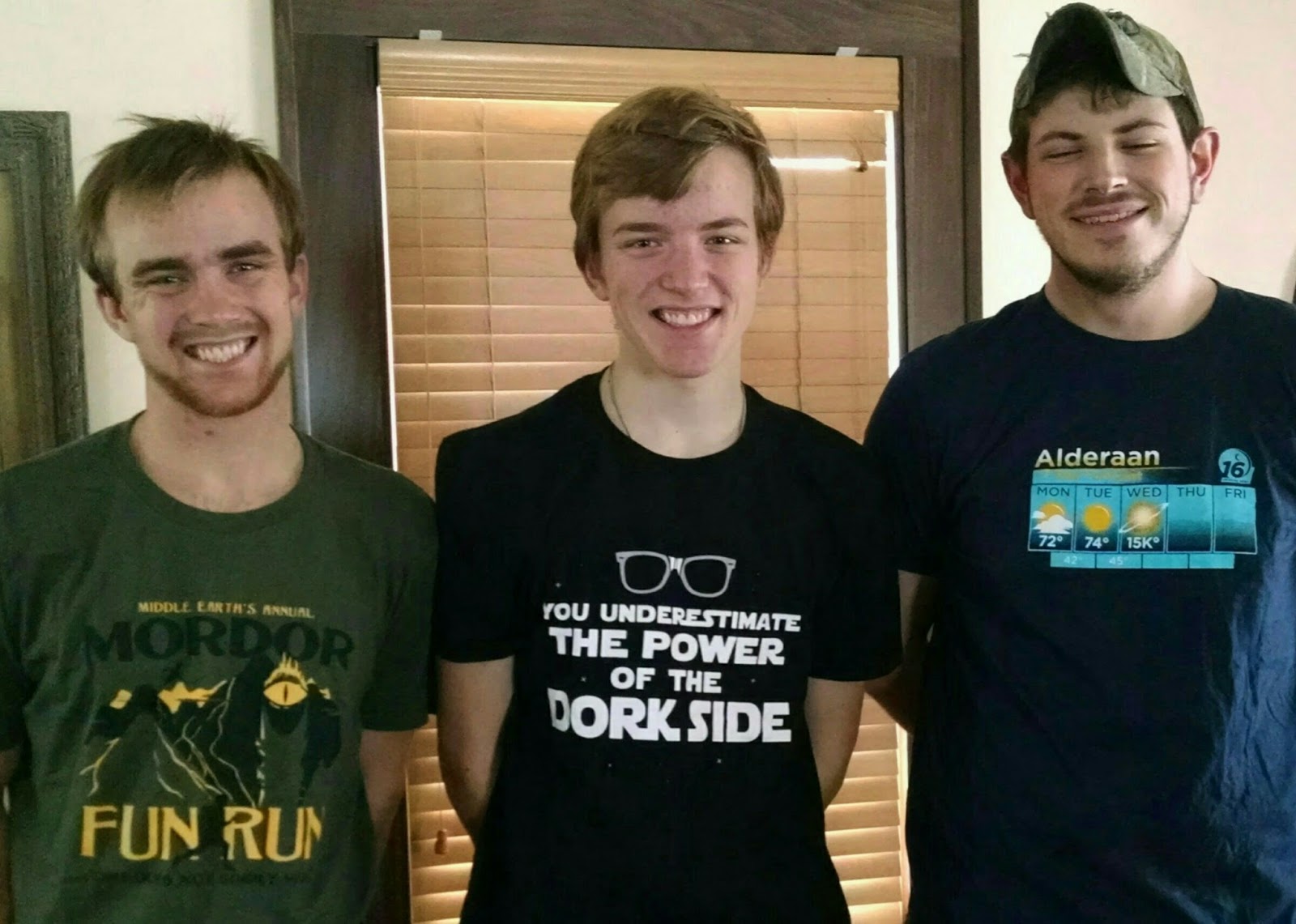
Speaking of cute faces- here's the Geek Squad in their Snorg tees from Xmas: The Mordor Fun Run, The Power of the Dork Side and the Alderaan Weather Forecast.

And in case you haven't heard, we are adding one more cute face this May when we'll welcome our first grandson!


@Golden Grasses 2008-2013. All photographs, artwork and text are the property of the owner unless otherwise stated. Don't miss a thing! Subscribe to Golden Grasses and get our articles right to your inbox!